Escaping Capitalism?
Published: February 20, 2026
Recently, my son said something that just, sommer, clicked. Here on holiday from one of the countries he has spent years living and working in, he said:
“They are not serious”
Poor Payers
I knew this in 1964 already, after visiting then Rhodesia, and discovering what a Bulawayo booking clerk for Rhodesian railways earned compared with the salary of a PMB friend doing the same job, and then gradually establishing that everything in Rhodesia paid better than everything in South Africa. At the time, I concluded it was a unspoken deal: Afrikaner Nationalists expected us to love being paid peanuts in exchange for keeping blacks out of job-contention.
Whatever, the reason, South African government and business have always been poor payers. Many wage- and salary-earners were driven to the stress of starting businesses, not only to rid themselves of a boss, but simply to pay themselves fairly.
The Capitalist class here in SA have never been serious about paying people. I had to reach three score and ten years to get a job that paid well enough for me to adequately clothe and feed myself, and attend to my health.
Of course, my son saying “they are not serious”, was talking about South Africa. Much as he loves his birth country, he battled financially for years in Cape Town while lecturing in a college. He left for Canada as animator and, apart from unemployment while stupid US movie studios dismantled the world movie business, has recovered. The college he lectured at in CT went under some years ago, and for all the joy he had from living here, the old Mr Micawber recipe for misery [ 1 ] ultimately drove him away.
I am old enough to have lived through the entire period of legislative apartheid in SA, plus a generation of so-called democracy. I am not being rude by calling it ‘so-called’. There will be no democracy until we can vote for the PERSON, not the party person, who ends up regulating my life in the local councils. In fact, I am unlikely to even consider anything to be seriously democratic until one simple thing is rectified:
The most productive people in SA are legally excluded from consultation over any law.
We do get a public holiday for voting. But that is for voting parties in, and that is the problem. Voting for a party is not voting for who I know and want, to represent me. Our by-laws are overseen only by people who have time to witness council meetings: unemployed or retired - people who are out of civic touch. It makes no sense. What the world seems to be, at last waking up to is the
“by the people, for the people”
part of democracy, the part that has never happened, because employers ensure that we can’t involve ourselves in daily democracy: they will not give us the time off to do so.
If I vote for an individual who I like and trust to represent me, I have only myself to blame if s/he has her wicked way with our finances, but at least I can blame myself. When a political party decides who represents me, I may be able to blame the party, but I have to wait up to five long years to hope to vote them out. I like many things about the OHM, but none more than their wanting laws to VOTE PEOPLE OUT. Why should we endure talentless, pathetic drones for five years? They should not survive public office unless they can share with us one thing per day they did for their first 90 days and beyond while in office. I am not a fan of the first 90 day law, but I relish the idea of a new 90 day law to monitor grootkop productivity. Anyone can sleep in parliament and public office, 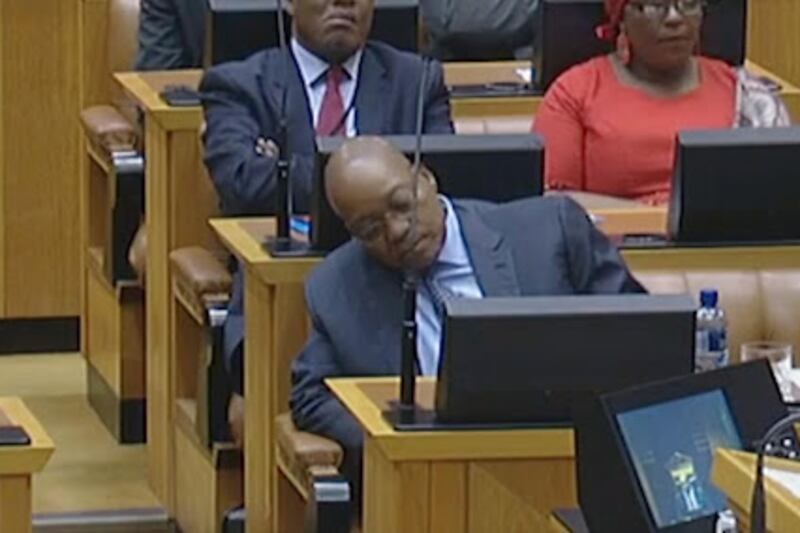 but they should forfeit their pay for those precious power naps.
A single useful deed per day is little enough to ask, yet, in my working life, I often shared offices with people who struggled to get one useful thing done per week. It goes without saying that the most obvious lack caused by democratic failure will be paypackets. We have unions, but how many office workers truly involve themselves? In South Africa, unions are largely seen as blue collar only. Do our office and media workers join the protests?
So, seriously, there is no way historically that voting in SA was ever democratic. But that is not what my son meant when he said SA was not serious. I have written elsewhere about pension payouts. One glance at what non-African countries pay their citizens when they retire reveals that they are serious, and we (and Africa) are not.
Pensions, though, are decided on by politicians, who also decide on public service pay. Private sector salaries are paid by businessmen. As someone wrote on Quora recently:
South Africa is not a developed country and it has never been one even when it was emanating “white awesomeness” during apartheid.
Compared to Zambia and Zimbabwe, South Africa is slightly better off but that’s like comparing India with Pakistan and Bangladesh and calling it a “ developed country”.
South Africa could easily have become one with just under 65 million people but the people in charge of South Africa are more interested in personal enrichment than making it a developed country.
The only people who thought SA was a developed country surely thought so because at one point we had a nuke. Just because we are one of the oldest nuke-capable countries in the world does not make us developed, and anyway, our nuke capacity was curtailed shortly before 1994, for well known reasons [ 2 ]
Social media repeatedly alleges that SA businessmen are sitting on a pile of two plus trillions in cash, that they won’t invest, citing of ’lack of business confidence’. It is their money, and we can do nothing about that, but what irks me is that once they do invest that cash, there is no sign I can see that signals a change of heart into how much they are likely to share it in terms of wages. Will the next administration be likely to increase the social pension? The increaes in old age social pension have been well under inflation forever, and nobody says anything. Has anybody seriously looked at what R2300 can actually buy in 2026? They surely have not. As my son said:
They are not serious.
He speaks with SA expats all over the world, and none can believe what passes for wages in the country of their birth. Sorry, biz-folk, but you are, and always have been, mean. Even the government pays better than ‘Captains of Industry’. That makes you ‘Captains of Misery’. Your wage traditions emanate straight out of the Charles Dickens City of London: the Boer republics probably paid better than (KZ) Natal, Johannesburg the cape provinces. You are not, and never were, serious. The second that wages are mentioned, your average Durban species began to use phrases like “it behoves us to … " [ 3 ]. Dickensian bores. Ugh. You claim to be risk-averse, but have actually been sharing-averse, for centuries. I don’t care how much billionaires give away:
- they can afford it
- they get rebates
- they get there by paying low wages.
There was a time when employers felt nothing topped the pleasure of being able to share, to pay people a real wage, to get the house, car, health care, schooling and time off that we need to live in dignity and grace. That was in my childhood days, when ‘profiteering’ was legislated against, when super-rich people paid super tax. They grumbled, but they paid willingly enough, especially when they enjoyed glassy smooth roads, valley-spanning bridges, tunnels, air- and other ports. At one time, American farmers and their workers ate at the same table. It was the ‘done thing’. Do they still? Did we ever?
When I was a kid, Switzerland had a few dairy farms, nothing else. Nobody wanted to live there. Today, if I were retired there, I would collect a pension equivalent to R52k pm. However you do the math, their seniors have more than five times the purchasing power I have. Not bad for a country that had once sold only cheese and chocolate.
Check their average senior citizen pension payouts in the global south. New Zealand, Australia will be high on the list. Why, when South Africa was once fabulously rich and developed compared with them, are we now paying seniors peanuts? Argentine and Brazil both align closer to NZ and Oz than us. Nothing else will show more clearly how the global north has skilfully extracted wealth from the global south. It turns out that people sitting on fabulous piles of natural resources are the poorest. Siriaas.
-
The Recipe for Happiness - Annual income twenty pounds, annual expenditure nineteen [pounds] nineteen [shillings] and six [pence], result—happiness. The Recipe for Misery - Annual income twenty pounds, annual expenditure twenty pounds nought and six, result—misery. (From David Copperfield by Charles Dickens) ↩︎
-
The Nationalist government did not trust liberation movements with nukes ↩︎
-
Or, even worse “behooves”, as spelled by Americans. Double ugh. ↩︎