Oberon Out?
Published: February 24, 2026
“Over and Out” is how I let AI channels know I am done.
Oberon is the subject of this post, more specifically A2 Oberon, an all-but-forgotten free, quick and tiny operating system, created by a famous Swiss computer scientist. Oberon (in cricketing terms) is ’not out’, after a long innings. Oberon’s innings opened in 1987, and Oberon has come and nearly gone, but it is still “in”.
Ho, Hum
I have long been tired of America’s bloated software: sell it, then fix it online always seemed fraudulent to me anyway, and now its bulk is forbidding. It appears I am no longer alone: some people have returned to writing PTA 1, because they start instantly. Returning to plain text in place of memory-hungry GUIs is a natural reaction. HLedger, as the lady in the YouTube video explains, displays simple text ledgers.
A2 Oberon is text-based, but looks like a GUI. The interface is described as a ZUI - Zooming User Interface. Like HLedger, it is tiny and starts instantly. It can run on hardware from 15 years ago with the speed of a modern supercomputer:
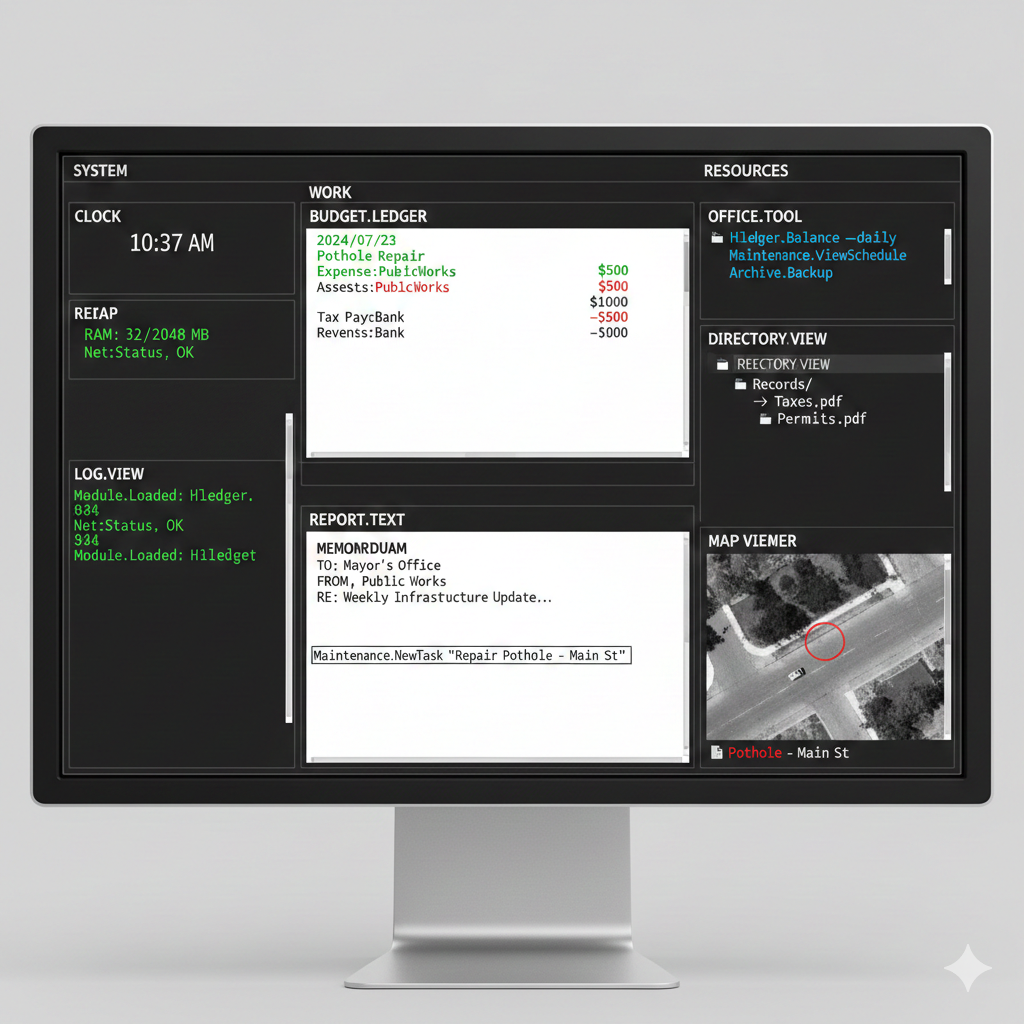
This pic is an AI mockup of how A2 Oberon would like running HLedger: very different from white characters on a black terminal screen, as HLedger appears in the video. It looks more “GUI” than “PTA”.
Few people even know that there is such a thing out there as Oberon, either as an operating system or as a programming language. Oberon is both: an operating system written in its own coding language, and a language that was considered a safe replacment for C++ by some. Note the left of the screen in the pic: 32MB of 2048. That is realistic. The original A2 ran on 4MB of RAM, making it thousands (millions?) of times more efficient than any of the Big Three.
Why change operating systems?
Government must use tax payer money efficiently. Can we get cheaper than “free” as in “no cost”?
- Windows and Apple are excluded right off the bat,on price. Yet you will find Windwows everywhere everywhere in government offices, Microsoft it could sell dirt cheap and get money back with lock-in.
- Linux is free - nothing to buy here! It runs quickly on older hardware. The other cost factors come up: ‘TINSTAAFL’. What you save on purchase you may spend in upkeep, a learning curve, and …
Updates
The Big Three (Apple, Windows and Linux) are heavily internet dependent for updates, with Windows being far away the most expensive, forcing users to pay for a Gb or more in update data along, nearly every month.
Linux, for government and civic use is:
- still quite big (40 million lines of code as at 2024)
- not that easy to use for beginners
- still update-dependent (not as heavy as Windows, but heavier than Apple).
Free Is Beautiful
Oberon seldom needs updates. It was ‘finished’ nearly forty years ago, and was always small: its academic code specification takes up 20 pages. The document laying out the creation of the entire Operating Sysem project is novel-sized at 300 pages. Compare that with the pecification for C++, which exceeds 1000 pages.
Russian school learners are productive users of Oberon within 2 weeks, and coders are effective within 3 to 5 months. It is familiar: it is ‘windows-lite’ to look at, but not to work with: program code and plain text are first class citizens, and screen text is in proportional fonts, rather than the two-tone type-writer-like text on pre-windows systems. You still have white on black or the reverse.
Programs launch straight from the document page: there is no separate program development editor. Refreshingly different, coder-comments are not just terse techno-pidgin in braces,2 but elegant proportional font prose around program code.
AI
EF Schumacher was not impressed by computing. He generally calculated quicker with his slide rule, but, in his day, there were no smartphones. Today, a slide rule is less likely to be quicker than a phone, but Schumacher’s slide rule answers were credible, his slide rule had no battery to go flat, and his own remarkable brain was trusted.
I will totally trust AI when it can ask (the right) questions. Paul Graham wrote:
“Nothing yields meaty problems like starting with the wrong assumptions. Most of AI is an example of this rule;”
And yet here we all are, using it.
Size counts, & counts & counts
Microsoft’s programming ID, Visual Studio Pro, is a thousand times heavier than its Linux equivalents. This is like saying a half-ton mini-car and a 100-ton locomotive can both pull only a quarter-ton wagon. In farming terms:
- Windows is Gariep dam and canals
- Linux is leiwater and flood irrigation
- Oberon is drip irrigation.
Decades ago, Oberon’s prolific and famous software creator, Niklaus Wirth, foresaw the bloatware problem and coined “Wirth’s Law”:
Software is getting slower more rapidly than hardware is becoming faster.
Hardware is not getting faster as quickly as it used to, chip manufacturers are reaching limits, and even if they succeed in migrating to optical computing, it will take time.
I contend that “Zoom meetings don’t fix potholes”, and “internet in municipal offices can be a distraction”. Everything we currently use comes with some degree of internet-related risk. Any risk is unacceptable for government. One way to avoid huge sums of money on software protection, is to use an operating system that is
- little known to virus and malware perpetrators and
- not in reach of the internet?.
Our communities and mayor’s offices can be connected in a more cost-effective network than via the internet.
Most people in civic jobs know what to do and how to do it. Researching the internet for better ways is for after hours: home-owners are fixing potholes because it does not happen any other way. ‘Public Works’ knows what to do, but does not do it. Apart from how questionable “meeting culture” is in the first place, service delivery is about doing more and talking less.
Enter A2 Oberon.
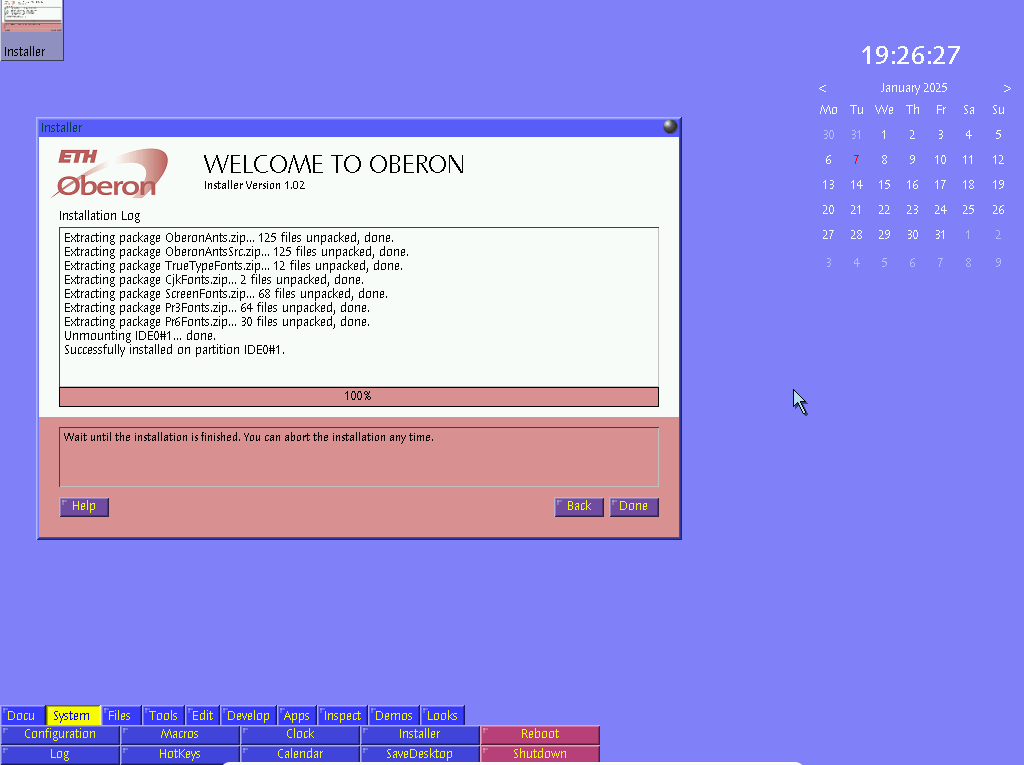
I am concerned with safety and a Calvinistic drive to get actual work done. By February this year, 6,000 government facilities and 32,000 Wi-Fi hotspots, including “gap” municipalities in the Eastern Cape and Limpopo, will, as far as I know, be connected, mostly by fibre. It should change everything, if it is allowed to.3. Oberon was designed to be network-aware from its start, meaning that inter-municipal emails on acountry-wide Wide Area Network will be perceived as instant. We do not need the internet for email.
- Everything to do with Oberon is small and quick, including learning it
- Connecting via a public-service-only system will save billions, and
- foster an IT generation, and
- apprentice thousands of youth into affordable-tech emploment
You can’t get safer than ‘away from the internet’ and you can’t get cheaper than ‘free’. Of course there will be costs. We pay billions blue-light cavalcades. Body-guarding is a young man’s job. So, you can argue, are IT jobs, but what does a plump forty year old bodyguard do? IT jobs are for life.
WAMS
There will always be crooks and chancers, but it is easier (and more acceptable) to surveill system administrators than 1.2 million office workers. Too many people in SA are WAMS - What About My Share?, believing they must get a cut on anything purchased. Buying nothing will cut that out.
Workers can leave their smartphones at security. Families can reach us on our desktop handsets. Do we go to work to talk, or to work? In ‘real’ civil service days, there was (in theory) an up-to-date manual or gazette, setting out how to do the job, who was who, and whom to call. Phone calls back then were ‘yes/no’ length!
One of Oberon’s criticisms may be around a spreadsheet program. Hooray! They are single greatest office virus risk. Coders will bleat “What about Python?” - nobody is happy with old languages yet COBOL still runs banking and ATMs (along with OS/2. Have you heard of that?). Blah-blah-blah. I don’t care. I am suggesting something workable. I may criticise, but I offer alternatives, and here is one.
Brevity
As a manager I rejected and ignored any letter longer than an A4 page, any (spreadsheet) table larger than an A4 page, and any memo longer than an A5 page, because the more you are writing about something, the less you are doing about it. For anything heavy, we scheduled a meeting, but they were known time-wasters, so nobody wanted to schedule one. It gave them a bad name. This scheme worked well!
Spreadsheets
I have listened to IT people scream blue murder about spreadsheet hell for three decades! Plus, who really needs 16,384 columns and 1 million + rows? I worked with Excel for many years: using a million rows of data works slower than a Karoo karretjie. Let the financial boykies use Excel or Calc, but remember, software bought from America may have FBI/CIA ‘back doors’. With open source, we can comb through it and kick out that dodgy stuff. And, let our new IT youth write our spreadsheet programs. There is much talk about creating ‘decent jobs’. We throw billions away daily, so why not spend some ’tjieng’ on something good, and make it ours, instead of R7.2 billion refurbishing railway carriages that we will never use again?
As the lead video to this article shows, Graphic User Interfaces are not necessary for office work, and A2 Oberon is much better looking than HLedger. Oberon has a history in South Africa :
We used Oberon (the system and the language) in our 3rd year CS OS course in Stellenbosch in the mid 90’s. Interesting system, it’s worth looking at since it has a few unexplored ideas … I experienced it at about the same time as win3 / Win95 and X-Windows (before KDE/Gnome) and it compared favourably.
A2 Oberon has been open sourced and developed further since that post. It is used by Russian school and university educators. Given that we are in BRICS, I think it is a natural choice: we like Russians, don’t we? It is free, as in free beer.
We have talked a little about size: The entire system download size is less than 150MB, and can run in that much RAM too. The original system ran in 4MB RAM. That means it will run on every old PC on every desk in every civic office in South Africa. It could need some software drivers, but government standardises on hardware, so few drivers would need to be written. Interns can wite them. We are awash with unemployed talent . American and European students have to write compilers in Computer Science courses. Writing drivers is much easier4, so there should not be a problem. Or, buyers can tell suppliers: no software driver, no buy.
Good starter projects would be to connect:
- Cape Town and George
- PMB and Thekwini
- East London and Gqeberha
and move to Pretoria and Johannesburg when those are working.
It will cost much, much less than refurbishing passenger coaches only to scrap them, and is a natural candidate for digitising our justice system. You can’t easily wipe a docket that is sitting on a server ‘somewhere’. For that, they would need to bribe a ‘sysad’5, and s/he would instantly become suspect number one.
I am not the only person wondering whether there is something smaller and better out there.
Plain Text Accounting ↩︎
Steve Mabbut of Khanyisa Real Systems coined ’techno-pidgin’ ↩︎
A Colesberg comrade told me the little grey boxes on telephone poles were for ‘spying on us’. ↩︎
It is not rocket science. I cut my Turbo Pascal coding teeth writing text drivers for printers in the 1980s. ↩︎
System Administrator ↩︎