REVIVING GARDEN ROUTE RAIL
Why?
If ever a project made sense for WC government funding, this is it. The line was completed in 1928. Private car ownership was rare: the Model T Ford had arrived a year before construction began in 1924. The population of SA was around 8 million at the time. Now it is 60 million.
Transnet's concession for the George - Knysna branch line route looks only at two options: Outeniqua Tjoe-Choo (passenger) and waste removal (freight). There is no point in delving too deeply into the document. It is alright as far as it goes, but is ill-conceived, confining itself only to this 67 km section, and appears to confine would-be investors to a two year agreement. No business can grow a profit in so short a time frame, so it lacks sincerity or credibility. Basically, it comes across as "fix the line for us, then we will grab it back". No business person will fall for that.
Like us, Japan had Cape Gauge (like SA) before the bullet train. Unlike us, they retain it, now running eight or more modern, quick and scenic regional railways. Some of them even look like the Garden Route. Our stronger case is to look at other use cases for reviving the Knysna - George railway, as well as looking beyond to connect to Cape Town. We can see many reasons for revival.
Respect
Our forebears paid for it. Tossing it away is an insult to their civilisation, and to the sweat, toil and even lives of people hewing it with picks, shovels, axes and dynamite.
Civilisation
Railways equate to civilisation. Growing our population sevenfold in a century is not a trend that will reverse. The N2 is getting clogged. Another highway will be gridlocked the day it opens, as with all highways. It will involve huge real estate purchases, yet we have this resource just lying around. You can’t even see it, right next to the N2, in many places. If you can’t see a railway, then it is not an eyesore.
Save lives
Hoekwil residents wrote recently on their social media channel that when trying to reach George Hospital urgently, they struggled to join the N2, and once on, they get no further than Kaaimans. Ambulances are a little quicker for the first problem, but the one I was on at dawn was delayed at Kaaimans: there was not even a gap to get through. This is a real concern for anyone living just off the N2.
This could be solved by using road-rail vehicles like this:
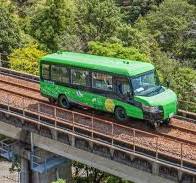
road-rail vehicle.
Pictured is a bus in Japan, able to switch from road to rail within minutes. Transnet uses vehicles similarly equipped for rail track maintenance.
Ambulance
The bus could just as easily be an ambulance. With the rail track revived, such an ambulance could drive to where there is a level crossing, switch modes, and by pass the N2 gridlock.
Fire
It could also just as easily be a fire engine. The rail route runs right next to forests in parts, providing easier access than from road. With our fire-history, this alone could save lives and property on a scale not currently possible. Sidings for water tankers could be built, on standy in fire-risk seasons.
Reduce emissions
Rail (excluding steam traction) beats road by multiples when it comes down to harmful pollution. For passenger rail, we would want trains, like this one:
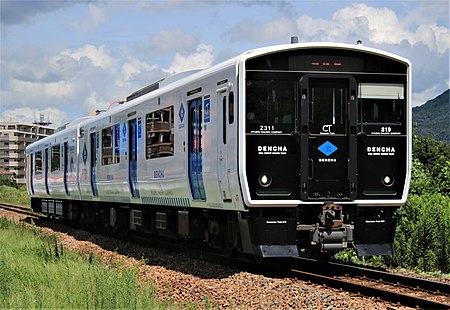
Battery Train
or one with a central power car like this:
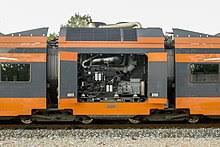
Central Power Car DMU
Reduce traffic
A typical EMU (Electric Multiple Unit) coach carries 50 seated and 100 standing passengers. That’s 300 in a two-carriage EMU like the one pictured. That is 10 minibus taxi loads per coach, or 20 taxis per trainset. That will save the length of 2 rugby fields of backed up traffic on the N2. Getting every school learner who is likely to use a train will need two trains running a few minutes apart each morning and afternoon. Sedgefield and Wilderness learners can be at school within 40 minutes of leaving home. Here is a typical timetable for the Knysna - George section, based on average section speeds of 78 kph:
| Station | Depart/Arrive |
|---|---|
| Knysna | 07h00 |
| Sedgefield | 07h20 |
| Wilderness | 07h36 |
| George | 07h50 |
Revive Rail Tourism
The Tjoe-Choo is a charming nice-to-have, but nothing functions like a modern train. Why not both? Tourists will be content to watch the beautiful coast glide by in the Tjoe-Choo, but, in off-seasons, learners and residents will enjoy a brisk punctual service. Stations will open up, with access to craft shops, restaurants, and beaches. EV transport to and from stations will become a thing.
Save Money
Building rail track costs roughly R20 million per km today. The existing line is washed away in four places. That is not even 4 km to rebuild, but even 20km rebuilt is cheaper than R1.4 billion for a new 70 km railway. The longer we wait, the more the billions become trillions.
In Part Two, we will cover how we see the railway being recovered: trainsets, infrastructure, other routes.